

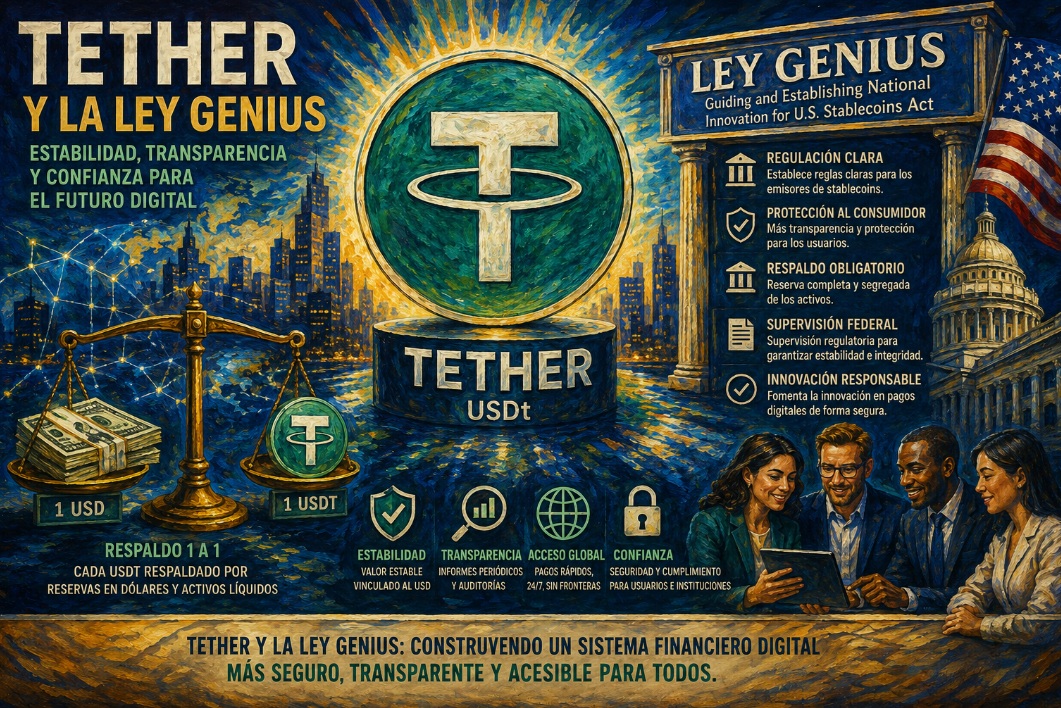
The GENIUS Act radically changes the rules governing Tether and USDT. What requirements does the US law impose on stablecoin issuers, and what does this mean for the crypto market, the state and individual users?
Tether and the GENIUS Act: two years to adapt to the new reality
The global cryptocurrency market is undergoing one of the most far-reaching legal reforms in the history of digital assets. As of July 2026, Tether, the issuer of the world’s largest stablecoin, USDT, has a transition period of approximately two years to bring its operations into line with the requirements of the GENIUS Act. After all, it was this Act that introduced the first comprehensive US federal regulations governing the issuance and circulation of payment stablecoins, emphasising full reserve backing, transparency, government oversight and the fight against financial crime.
What is the GENIUS Act?
The GENIUS Act (Guiding and Establishing National Innovation for U.S. Stablecoins Act) is a US federal law signed by US President Donald Trump in July 2025. The legislation established a unified legal framework for the regulation of payment stablecoins.
The Act imposes strict requirements on issuers:
• a 1:1 reserve backing for tokens;
• the use of only highly liquid assets (cash, bank deposits, short-term US Treasury bills);
• regular disclosure of information regarding reserves;
• mandatory compliance with AML (anti-money laundering), KYC (know your customer) and sanctions legislation;
• the right of a stablecoin holder to redeem it at face value.
Why has Tether come under the spotlight?
Tether Limited issues the world’s largest stablecoin, USDT, with a market capitalisation (as of July 2026) of over US$160 billion. USDT is used as the primary settlement asset on most cryptocurrency exchanges and in international cross-border payments.
However, Tether is registered outside the US, so in order to operate fully in the American market, the company must comply with the requirements of the new legislation or operate under a different regulatory model. This is why the next two years could prove decisive for the future of USDT.
What prospects does the law open up?
For the US, the GENIUS Act means increased oversight of digital dollar assets, enhanced financial stability, a more effective fight against money laundering and terrorist financing, and a strengthening of the dollar’s international role in the digital economy.
For the crypto sector as a whole, the law effectively legalises the stablecoin model within a clear legal framework. This could encourage not only institutional investors but also banks and major financial firms to enter the digital assets market.
For users, the new requirements will mean an even higher level of protection, more transparent reserves, a lower risk of USDT losing its peg to the US dollar, and clear token redemption mechanisms.
At the same time, compliance with the new requirements will entail significant costs for issuers, which could lead to market consolidation and intensified competition among the largest companies.
The GENIUS Act has already become one of the most significant pieces of legislation in the history of cryptocurrency regulation. It shifts the stablecoin market from a regime of partial self-regulation to full state oversight. For Tether, this means it will need to adapt its corporate structure, reserve policy and compliance practices to US standards. If the company successfully meets the requirements of the Act, USDT will retain its leading position. If not, the global stablecoin market could face a major realignment of power.
FAQ
1. What is the GENIUS Act?
The GENIUS Act is a US federal law that establishes uniform rules for the issuance, backing and supervision of payment stablecoins.
2. Why is the Act important for Tether?
Tether is the issuer of USDT – the world’s largest stablecoin. To operate in the US market, the company must bring its activities into line with the new requirements.
3. What are the main requirements for stablecoin issuers?
Full 1:1 reserve backing, government supervision, regular reporting, compliance with AML/KYC regulations, and the user’s right to redeem tokens.
4. What will change for USDT holders?
Once the law comes into force, greater transparency regarding reserves, better legal protection and a reduction in systemic risks are expected.
5. What does the GENIUS Act offer the state?
The Act strengthens financial oversight, makes it more difficult to use stablecoins in illegal transactions and supports the global role of the US dollar.
6. Will the Act affect the global crypto market?
Definitely yes. It could become an international benchmark for stablecoin regulation and influence legislation in other countries.