

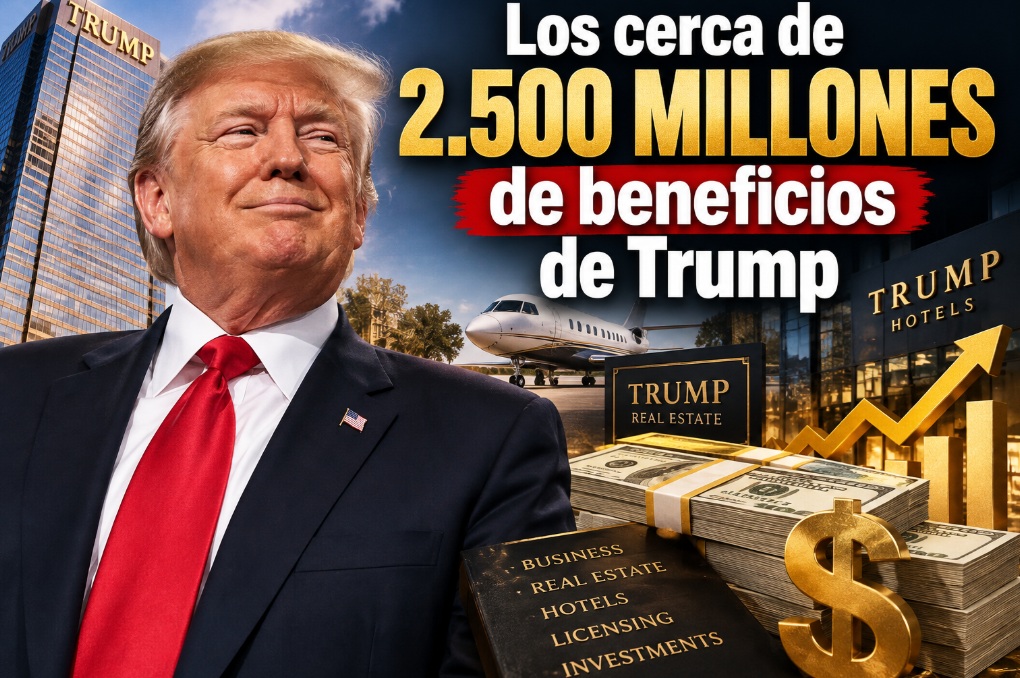
Donald Trump has transformed cryptocurrency from a campaign pledge into a large-scale family business. According to Reuters estimates, between the 2024 election and April 2026, entities linked to the president generated around $2.3 billion in pre-tax revenue from several crypto ventures. At the same time, Public Citizen estimates that investors in five Trump-linked crypto products have suffered losses of at least $4.7 billion. However, it is important to highlight a key legal detail: a significant portion of these losses are ‘paper’ losses – that is, unrealised – rather than money that has literally disappeared from investors’ accounts.
$TRUMP, WLFI and billions on the family’s side
The hardest hit was the $TRUMP meme coin. Public Citizen estimates the total decline in the value of retail investors’ holdings at approximately $3.2 billion. A further $1 billion or more is attributable to the WLFI token, around $450 million to the fall in Trump Media’s share price following the creation of its cryptocurrency treasury, whilst losses incurred by Trump NFT holders are estimated at $9.3 million or more. USD1 did not result in a similar loss for holders in this calculation, as it is a stablecoin pegged to the dollar.
Meanwhile, Trump’s 2025 financial disclosure showed over $1.4 billion in profits, a significant portion of which was linked specifically to the crypto business. Reuters estimates the family’s total crypto income following the election at $2.3 billion. The family receives income from the sale of tokens, royalties, shares and commissions, whilst the buyer bears the risk of a fall in the asset’s market price.
UAE: $500 million for a stake and $2 billion via USD1
The most intriguing story, in which legal and political aspects are closely intertwined, begins in the United Arab Emirates. An entity linked to Sheikh Tahnoun bin Zayed Al Nahyan agreed to acquire a 49 per cent stake in World Liberty Financial for approximately $500 million. Later, the Abu Dhabi-controlled fund MGX used $2 billion in the USD1 stablecoin to invest in Binance. The $2 billion itself did not constitute direct profit for World Liberty, as the economic benefit lay, in particular, in the ability to manage the USD1 reserves and generate returns from their investment.
Presidential business granted banking status
In August 2026, the Office of the Comptroller of the Currency provisionally approved the establishment of World Liberty Trust Company. This is not a conventional commercial bank: the entity will not be authorised to accept traditional deposits or issue loans, but will be able to operate with USD1, reserves and digital assets. At that time, USD1 had a market capitalisation of around $4 billion.
This is where Trump’s crypto business reaches a new level. Private tokens, foreign capital, financial regulation and political power have all been brought together under one umbrella.
Does this break the law?
No. The US President is not subject to the standard federal rules on conflicts of interest that apply to many other public officials. Separately, there is the Foreign Emoluments Clause of the US Constitution, which restricts public officials from accepting gifts, emoluments or other benefits from foreign states without the consent of Congress and creates a distinct set of legal issues regarding benefits from foreign states; however, the mere existence of a foreign commercial investment does not constitute a breach of this provision.
The Office of Government Ethics confirms that the President and Vice-President are not subject to the main criminal provisions on financial conflicts of interest under 18 U.S.C. §§202–209, in particular §208. However, this does not, in fact, mean that the President is exempt from all anti-corruption regulations. The GAO explicitly states that the President and Vice-President are subject, in particular, to the federal prohibition on bribes and illegal gratuities under 18 U.S.C. §201.
However, there is another telling precedent: Binance, which found itself in the spotlight following a large-scale investigation by the US Department of Justice into transactions worth USD1. In 2023, the exchange pleaded guilty to federal charges relating to breaches of US anti-money laundering legislation and agreed to pay fines totalling over $4.3 billion, whilst its founder, Changpeng Zhao, pleaded guilty to breaching AML requirements.
What risks exist at present?
The main risk facing Trump’s crypto empire today is systemic. This arises when the president simultaneously influences the rules of the crypto market, holds assets whose value depends on those rules, and has business ties with foreign investors.