

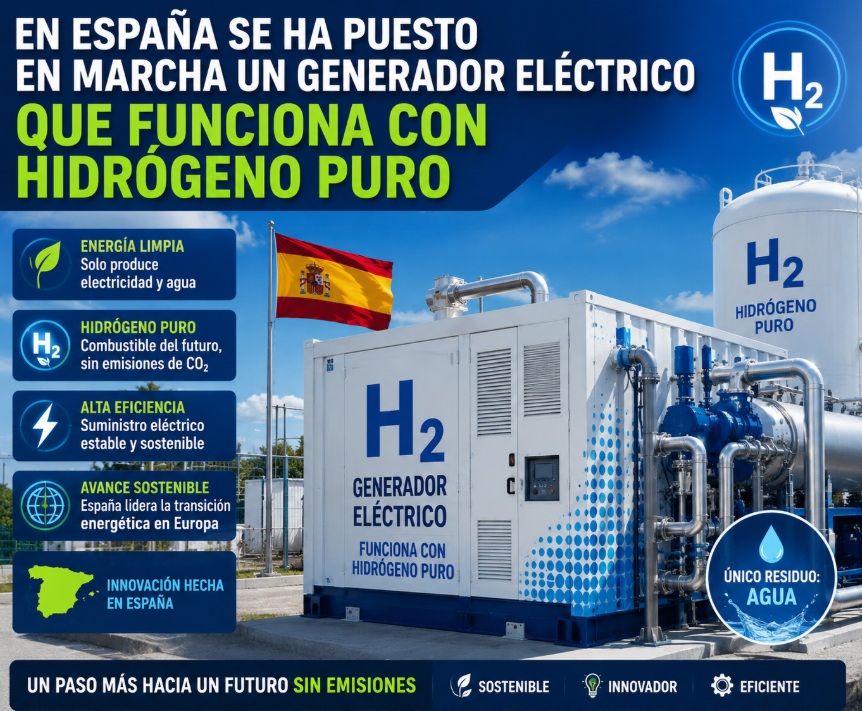
Spain has taken a huge technological leap that could impact not only the energy sector but also the entire future of the crypto industry. The Finnish company Wärtsilä has successfully launched the world’s first large-scale power generator running on 100% pure hydrogen in the town of Bermeo in the north of the country. Scientists and developers regard the project as a global breakthrough in the field of carbon-free electricity generation.
Mining Bitcoin and other digital assets remains one of the most energy-intensive processes in the digital economy. That is precisely why any source of stable energy automatically attracts the attention of the entire crypto industry. According to estimates by the Cambridge Centre for Alternative Finance, the global Bitcoin network consumes over 150 TWh of electricity annually, which is comparable to the energy consumption of some small countries.
The new Wärtsilä 31H2 hydrogen engine is the world’s first demonstration of a large-scale generator that runs exclusively on pure hydrogen, without any natural gas admixture. The technology is designed to balance power systems during periods when solar and wind power stations are not generating enough electricity.
Assuming that a single Wärtsilä 31H2 generator operates at around 10 MW of electrical power throughout the year, it is capable of generating approximately 87.6 million kWh of electricity. Given current equipment efficiency, this is equivalent to a potential annual output of around 25–35 Bitcoin. Accordingly, over two years, the figure could reach 50–70 BTC, and over three years – 75–105 BTC. Despite the promising theoretical figures, the final result depends on the network’s difficulty, the Bitcoin exchange rate and the type of miners.
Many countries and research institutions around the world are actively and successfully working on hydrogen generation. However, the top seven countries that have been most active in researching or implementing hydrogen generators and engines include only Spain (University of the Basque Country), Finland (LUT University of Technology), Germany (Technical University of Munich), Japan (University of Tokyo), the USA (Massachusetts Institute of Technology), the UK (Imperial College London) and South Korea (Korea Advanced Institute of Science and Technology).
Technology experts believe that using hydrogen-generated electricity for cryptocurrency mining is technically feasible, but the economics of such projects will depend on the cost of producing the hydrogen itself. The positive outcomes could include the near-total absence of CO₂ emissions and the ability to provide a stable power supply to data centres, even with a high proportion of solar and wind generation. A negative factor is the relatively high cost of production. In the current climate, the storage and transport of hydrogen significantly exceed the costs associated with traditional energy sources.
However, the scope of application for such installations is considerably broader. The most likely areas of use will be: data centres and artificial intelligence facilities, backup power for electricity grids, the metallurgical and chemical industries, transport infrastructure and ports.
We should not expect hydrogen generators to become widespread over the next five years. However, the situation could change dramatically over the next 10–15 years. International decarbonisation programmes, the development of renewable energy and the falling cost of hydrogen could make such installations a common feature of energy systems. And, if the cost of hydrogen production continues to fall, the technology could power both cryptocurrency mining farms and entire sectors of the economy, accelerating the global transition to low-carbon energy.