

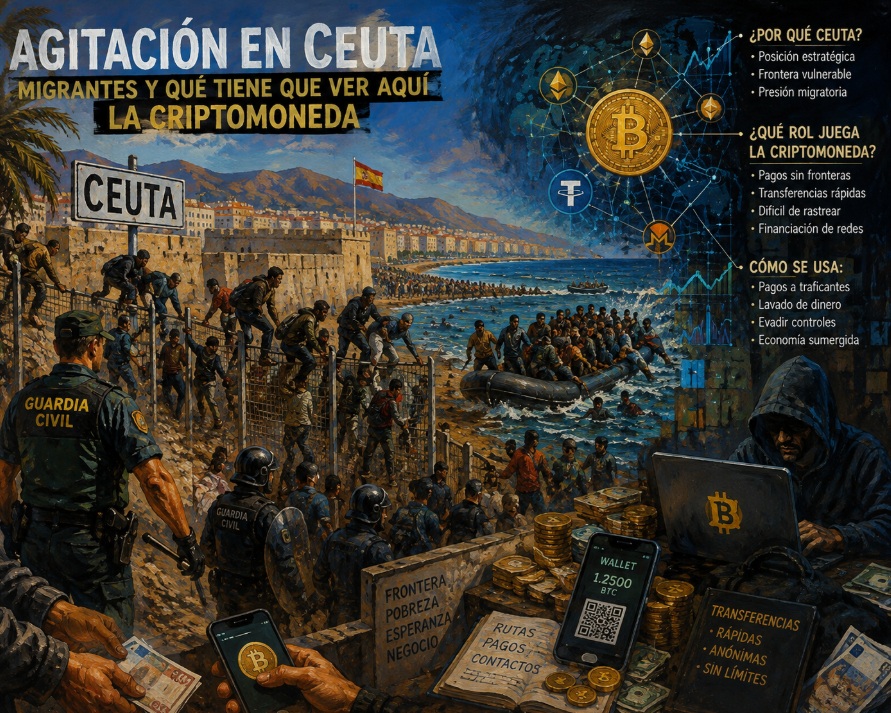
The mass influx of illegal migrants into the Spanish enclave of Ceuta has once again brought into sharp focus not only the issue of securing the European Union’s external border, but also the financial mechanisms used by international organised crime groups.
At the end of July 2026, tens of thousands of people – around 50,000 to 60,000 migrants – attempted to enter the Spanish enclave from Moroccan territory. According to various estimates, the scale of the crisis was the largest since 2021. At least 57 people (figures are subject to change as events unfold) have already lost their lives during the perilous sea crossing.
Ceuta remains one of the two land borders between the European Union and Africa. This is precisely why the city has for many years been at the forefront not only of illegal migration but also of the activities of international criminal networks, including smugglers.
What does cryptocurrency have to do with this?
There is currently no direct evidence that the latest mass attempt to breach the border into Ceuta was financed by Bitcoin, USDT or other digital assets. However, cybersecurity experts and blockchain analysts have been observing a trend for several years now that is spreading and growing: human trafficking networks are increasingly using cryptocurrency as one of their alternative payment methods. This is evidenced by numerous investigations by Europol, UNODC, the FBI and analytics firms (TRM Labs, Elliptic, Chainalysis).
The reasons are obvious. After all, international transfers are processed much faster, and funds can be accessed in virtually any country. Furthermore, criminals use mixers, anonymous wallets and payment chains to complicate investigations.
This is precisely why blockchain analytics has now become one of the most important and crucial tools in the fight against organised crime. European law enforcement agencies are increasingly collaborating with companies that analyse crypto transactions to identify financial flows linked to human trafficking, money laundering or drug trafficking.
The Spanish authorities regard the activities of criminal organisations as one of the main factors behind the current crisis and, following the events in Ceuta, are accusing organised networks of smugglers of spreading disinformation among potential migrants regarding an allegedly simplified border crossing process.
Why are migration crises increasingly becoming a focus for blockchain analysts and financial intelligence?
For the global cryptocurrency market, this story occupies a distinct niche and holds particular significance. Every large-scale case linked to the financing of illegal migration drives tighter regulation of digital assets, KYC and AML procedures, transaction monitoring, and cooperation between crypto exchanges and law enforcement agencies, amongst other measures. And the fight against illegal migration itself is increasingly moving beyond the scope of conventional border policy and into the realm of financial intelligence and blockchain forensics.
The events in Ceuta demonstrate once again that modern migration crises are not merely humanitarian and political challenges. They are also becoming a test of digital financial security, where cryptocurrency, whilst not the cause of migration, can be used by certain criminal networks as a tool for international transactions, forcing states to invest ever-increasing resources in blockchain monitoring and international cooperation.