

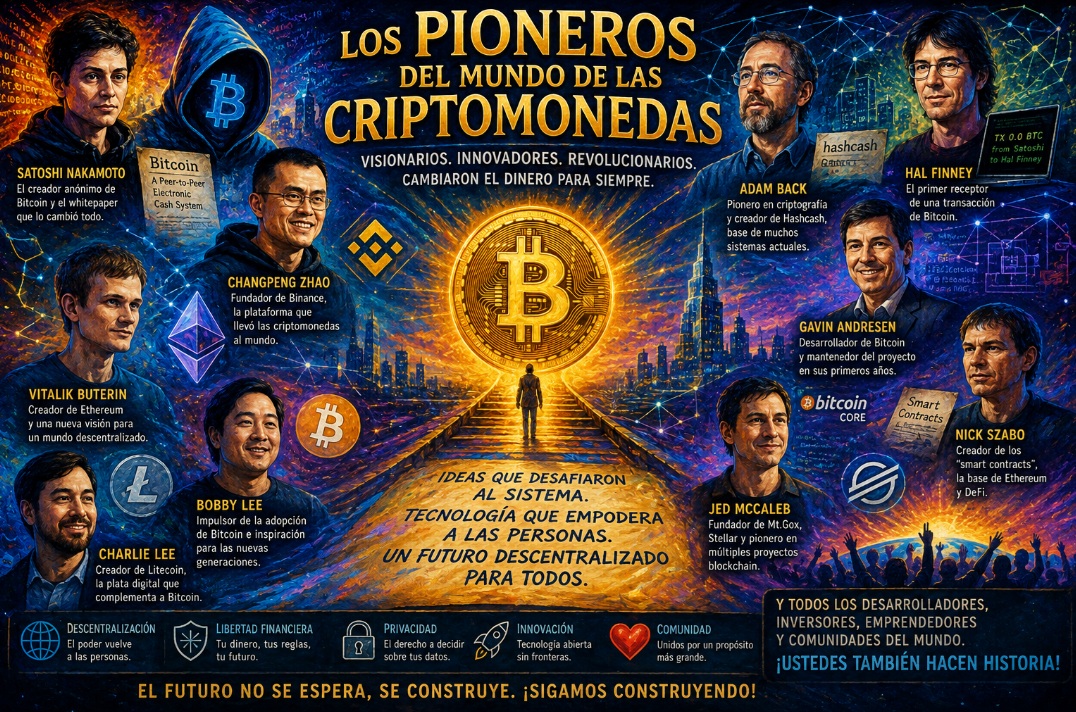
The world of cryptocurrencies has its roots in long-standing academic research. Mathematics, computer science and the theory of distributed systems have become the foundations of a technology now valued at trillions of US dollars. Thus, Bitcoin is the result of research into cryptography, number theory, computer networks and other fields.
Today, blockchain is used in finance, logistics, medicine, cybersecurity and public administration, whilst Bitcoin (BTC) and Ethereum (ETH) remain the two largest crypto-assets by market capitalisation. Every day, more and more investors are viewing crypto-assets as one of the tools for diversifying their capital – either as an alternative to, or alongside, shares, precious metals and bank deposits.
The initial ideas that led to the emergence of blockchain arose decades before the launch of Bitcoin. In 1976, American cryptographers Whitfield Diffie and Martin Hellman published the groundbreaking paper *New Directions in Cryptography*, which pioneered public-key cryptography. In 1977, Ron Rivest, Adi Shamir and Leonard Adleman introduced the RSA algorithm, which subsequently became one of the most important standards for digital encryption.
The next stage in the industry’s development began in 1991, when Stuart Haber and W. Scott Stornetta proposed a cryptographic timestamping system that ensured digital documents could not be altered without detection. As early as 1992, researchers integrated Merkle trees—invented by Ralph Merkle back in 1979—into their model. It is this very technology that is used today in Bitcoin for the efficient verification of transactions.
In 1998, cryptographer Wei Dai published the concept of b-money, whilst almost simultaneously Nick Szabo presented the Bit Gold project. Both works proposed a model of digital money without a central bank and became the most important precursors to Bitcoin.
The culmination of this research came on 31 October 2008, when a technical paper entitled ‘Bitcoin: A Peer-to-Peer Electronic Cash System’ was published under the pseudonym Satoshi Nakamoto. And on 3 January 2009, the first block of the Bitcoin network – the Genesis Block – was created. Thus, the world’s first successful decentralised blockchain was born.
The combination of blockchain, artificial intelligence, quantum-resistant cryptography and biocomputing could significantly accelerate the development of the global digital economy. Scientists are currently working on cryptographic algorithms that are resistant to future quantum computers – this is of paramount importance for the long-term security of digital assets.
Cryptography is the science of methods for protecting information using mathematical algorithms. It is cryptography that enables digital signatures, block immutability, the protection of private keys and the secure transmission of data across blockchain networks.
Biocomputing is considered an important and promising field. It is a discipline that explores the use of biological processes, DNA molecules, cells and other biological systems for computing and storing any kind of information. Today, this is predominantly an experimental field; however, in the future, it has the potential to deliver extremely energy-efficient computing and radically new approaches to cryptography, provided the relevant technologies reach practical maturity.
For entrepreneurs and investors, the greatest long-term value lies in technologies that solve real-world problems, as well as in the reliability of the technology – specifically, the security of the blockchain and decentralisation. Practical applications are also important – such as the use of the network for payments, smart contracts, asset tokenisation, DeFi and so on. After all, potential returns in the crypto sector are linked not only to the rise in asset values but also to the development of innovative infrastructure – which is precisely why one should only invest after a thorough analysis of the project, an assessment of one’s own risk tolerance, and an awareness that the high potential returns of cryptocurrencies are always accompanied by a high probability of losses.
The history of cryptocurrencies shows that the greatest technological breakthroughs in the global arena stem from fundamental science, and it is precisely decades of research in cryptography, computational theory and other exact sciences that have laid the foundations for modern blockchain technology.