
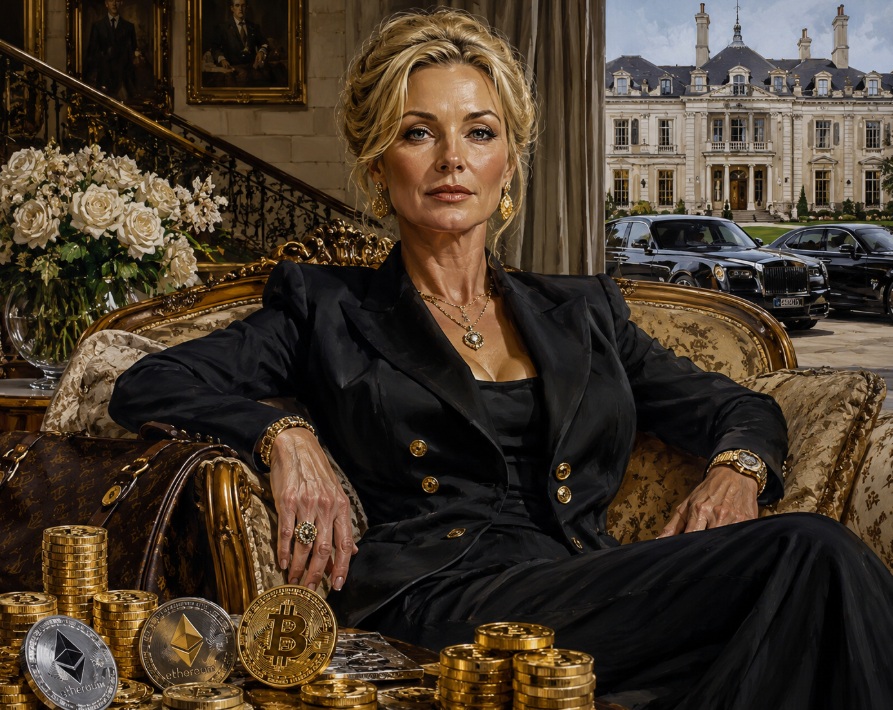
The story of a woman remembered not as an heiress to millions, but as the woman who, in April 1974, organised and took part in one of the biggest art heists in 20th-century history. Art historians later acknowledged that this was the biggest heist of its kind in British history and that ‘no amount of money could compensate for the loss of these beautiful objects’.
The story of Bridget Rose Dugdale, the daughter of a Lloyd’s underwriter who grew up on a luxurious 600-acre estate in Devon, studied at Oxford (St Anne’s College) and a PhD in economics, paints a personal life story that began long before the crime. Today, it is hard to imagine such a heist taking place in the 2020s using cryptocurrencies – Bitcoin (BTC), Ethereum (ETH) or USDT.
‘Born into a privileged family in 1941, she seemed destined for a comfortable life in high society. She was brought up by a French governess, studied at elite European boarding schools and was a debutante presented to the Queen. From childhood, she was groomed for a life in country estates and social duty with a suitable husband of impeccable lineage,” the world press will write.
Subsequently, the media noted that even then, beneath the silk of her expensive dresses, lay a sharp mind seeking justice in an unjust world – whilst at university, she and a friend, having dressed in men’s clothing, infiltrated a debate at the Oxford Union as a protest against restrictions.
Other news outlets, in their pursuit of a scoop, will seek answers to questions of a psychological nature, pointing out that it all began in 1968, when Dugdale found herself at the epicentre of student protests. It was at that very time that her personality and character changed radically. It is known that she donated her share of the inheritance, £150,000, to help the poor in north London. At the time, this was an exorbitantly large sum, although as of May 2026, it amounts to approximately 2.47 BTC.
For their part, forensic experts emphasise that the heist was planned with a precision that only modern quantum computers can boast.
In a matter of minutes, the criminals stole 19 paintings, including masterpieces by Francisco Goya, Thomas Gainsborough and Peter Paul Rubens. The most valuable paintings in the collection – Jan Velázquez’s ‘The Lady Writing a Letter with her Maid’, Frans Hals’s ‘Portrait of a Cavalier’, and paintings by Gabriel Metsu – were small enough to fit into the gang’s Ford Cortina estate car. The total value of the stolen goods was estimated at over £8 million. This heist was the biggest in history at the time.
In today’s world, a similar scenario could involve the theft of tens of millions in Bitcoin or Ethereum, transferred via mixers and decentralised exchanges. Cybercriminals would use social engineering, credential theft and multi-layered transactions to cover their tracks. But the foundation of the crime would remain the same — meticulous planning, the human factor, and the exploitation of vulnerabilities in the system.
This story, which later became a symbol of the complex life choices a person faces, illustrates the complexity of a woman’s fate in a changing world where social roles are shifting. From a privileged upbringing to involvement in one of Europe’s most notorious crimes. A choice made in the shadow of big money turned life into a drama where luxury and ideology became two sides of the same coin.
A rebel from the elite, Bridget Rose Dugdale, died in Dublin on 18 March 2024, aged 82. She went down in history as a figure who embodied the paradox of the era: a woman who had everything, yet chose a path of self-sacrifice and violence for the sake of an idea she considered higher than her own life. Her life story is a profound exploration of how social inequality and political passion can transform an English lady into a revolutionary icon, whose shadow still haunts the corridors of art galleries across the globe.