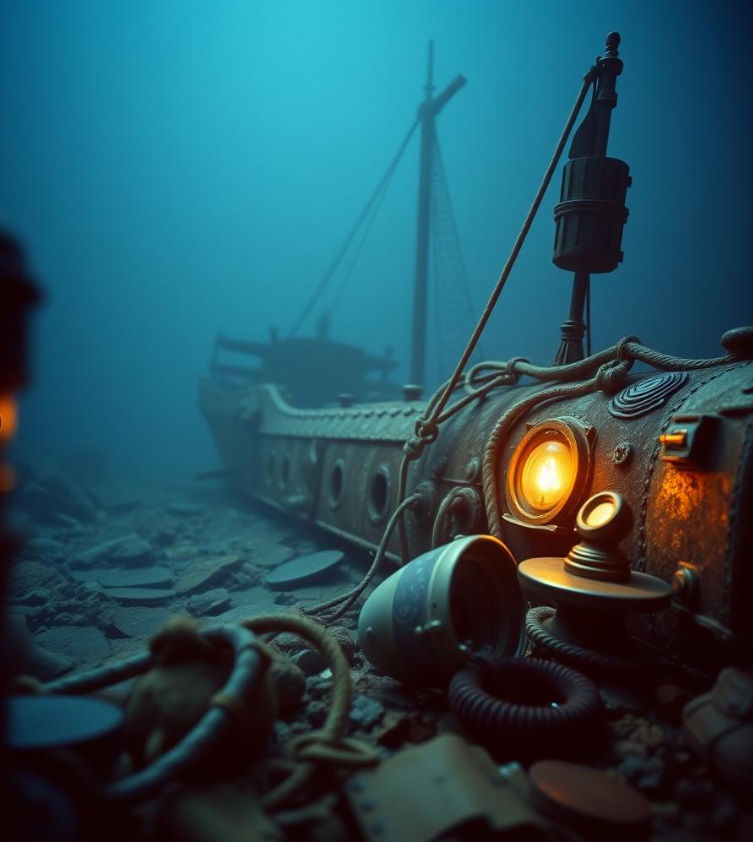
I was told this story in a port where the air smells of salt and the ropes and cables creak like old accounts of fate. Almost 140 years ago, the steamship ‘SS Nantes’ vanished into the cold waters near Plymouth. And for a long time, the mystery of the sunken ‘SS Nantes’ remained unsolved – the ship disappeared in November 1888 after colliding with the German sailing vessel ‘Theodor Ruger’ off the coast of Great Britain. Despite the interest of local residents, the coordinates of the wreck site were unknown due to the lack of modern navigation, and the wreckage remained scattered on the seabed. Back then, the sea did not explain its decisions. It simply took what it deemed necessary in silence.
A modern expedition led by British diver and explorer Dom Robinson was able to identify the wreckage by finding fragments of ceramic tableware bearing the coat of arms of the shipping company Cunard, which provided the decisive evidence confirming that it was indeed the ‘SS Nantes’ lying at a depth of approximately 75 metres in the English Channel. “There are very few secrets left to explore in this world,” he commented. And this phrase became the key not only to the sea, but also to the crypto market.
For the sea and the crypto market are strangely similar. A captain trusts charts, a compass and a wealth of experience. A trader trusts data, models and cold calculation. Both know this: risk does not disappear; it merely changes form. Once upon a time, captains studied currents and wind patterns. Today, investors study blockchain – an open ledger where every action leaves a trace, like a ship’s wake on the water. Where there is no centralised helm, discipline and route verification prevail.
Although attempts were made to save the ship using whatever was to hand, and the crew spent time after the collision trying to stop the water from pouring in – the sailors plugged the hole in the hull with mattresses – this did not prevent the disaster. Debris from the tragedy washed up on the shores of neighbouring counties, and of the more than twenty crew members, only three survived: two jumped onto the ‘Theodor Ruger’, and one remained on the ‘SS Nantes’ for as long as possible before the ship sank. The bodies of the other victims and the wreckage of the ship were found on the beaches of Cornwall near Talland Bay and Looe.
Cryptocurrency is as unforgiving of carelessness as the sea. Volatility is a storm of sorts. Leverage is an overloaded deck. A lack of risk management is a night without the light of a lighthouse. But there is a difference: on the blockchain, memory does not sink, transactions are stored, mistakes are analysed, and lessons are etched into memory.