
The Strait of Hormuz is one of the world’s most important maritime routes, through which around 20% of global shipments of oil, liquefied natural gas (LNG) and various industrial goods, including electronics and livestock, pass. Against a backdrop of high geopolitical tension in the region, a new threat has emerged: cryptocurrency is being used as a tool for fraudulent schemes targeting shipowners and captains.
The situation surrounding the Strait of Hormuz highlights a new level of evolution in fraud, as cryptocurrency is becoming a global tool for manipulation in the world’s maritime logistics. Indeed, according to the latest data from global cybersecurity experts, over 60% of new fraud schemes in 2025 involved cryptocurrency as a payment method. Meanwhile, The Washington Post reports to the global community: ‘US President Donald Trump has announced that he is suspending a new military operation to clear a transit route through the Strait of Hormuz for commercial vessels. This halted a mission that had only just begun, whilst over 1,500 merchant ships are still waiting for the opportunity to pass through the critical waterway blocked by Iran.”
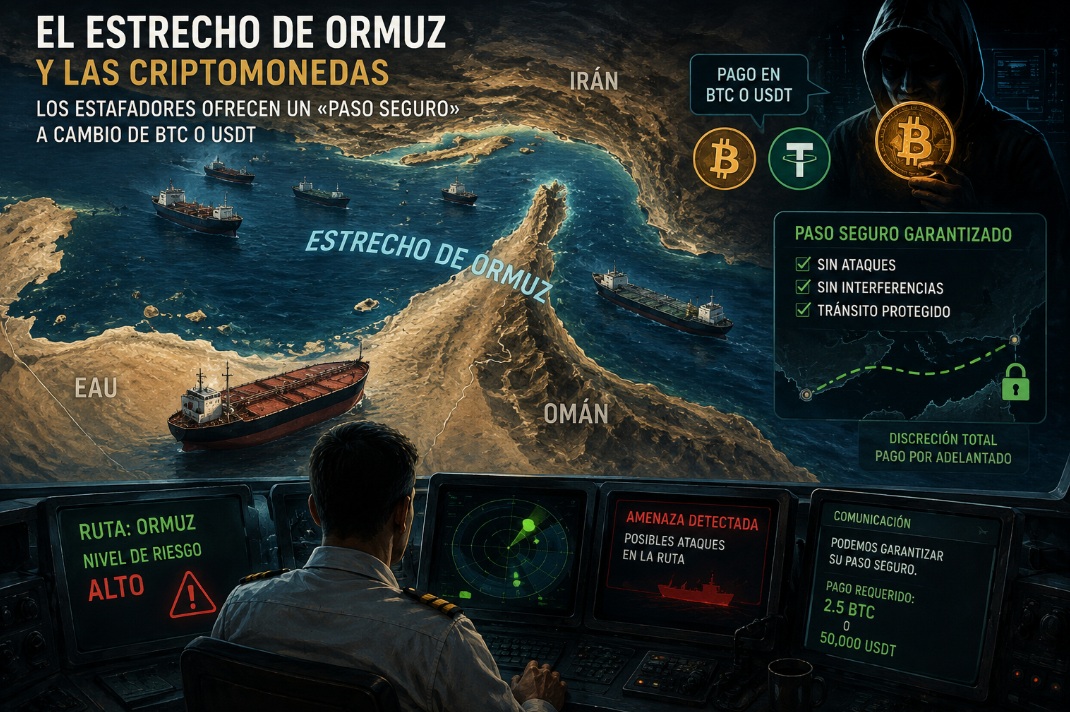
In general, in 2025–2026, international shipping companies began receiving strange messages offering to pay for a ‘guaranteed passage’ through the strait. Despite this, the Iranian authorities do not levy any fees in cryptocurrency for passage through the strait, as navigation is governed by international maritime law.
Most spam messages read along the lines of: “Once you have submitted the documents and your compliance with the requirements has been assessed by the Iranian security services, we will be able to determine the amount of the fee to be paid in cryptocurrency (BTC or USDT). Only then will your vessel be able to pass through the strait unhindered at a pre-agreed time.”
It is noted that such demands are not provided for under international maritime law, are not recognised by any state, and are classified as financial fraud. In most countries, such actions are subject to severe criminal liability.
How the scheme works
The fraudsters pose as one of the ‘security services’ or intermediaries. The shipowner or captain receives a letter or a message via a messaging app, demanding documents for verification and setting a ‘fee’ in BTC/USDT. The fraudsters quickly disappear as soon as the cryptocurrency reaches their accounts.
Fraud in maritime logistics is widespread. Similar schemes have been reported in the UAE (logistics hubs), Singapore (maritime routes) and most offshore jurisdictions. Experts note: this is a tried-and-tested, classic scheme using social engineering, adapted for maritime logistics.
The answer to the question of what shipowners and captains should do is obvious:
Always verify the source of information. All fees are paid through official financial channels, and authorised bodies do not require payment in cryptocurrency.
Ignore any requests for BTC/USDT. Any request to pay an official fee in cryptocurrency is a scam.
Report incidents to the International Maritime Organization, international police forces and national law enforcement agencies.
Fraudsters use crypto platforms and currencies due to the anonymity of transactions, the speed of international transfers, the difficulty of tracing payments and the lack of a refund mechanism.
Currently, the comprehensive fight against crypto fraud is taking place on several levels: informing shipping companies, tracking crypto wallets, international cooperation between law enforcement agencies, monitoring existing schemes and modelling new threats. Organisations such as international financial regulators and the FBI are involved in the process.